

What are cataracts?
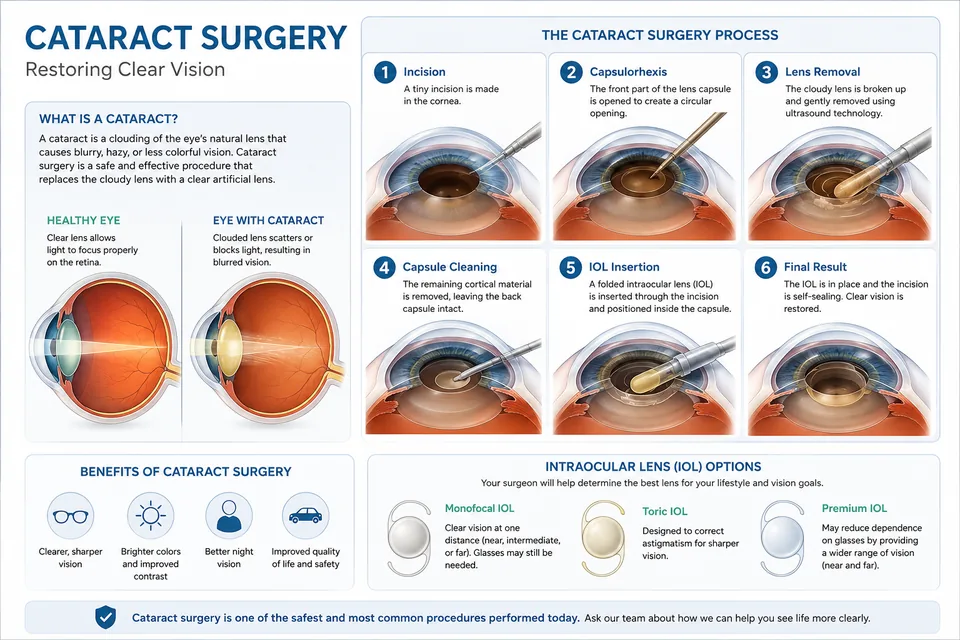
A cataract is the gradual clouding of the natural lens inside the eye that can impair vision. More than half of all Americans age 65 and older have cataracts in their eyes.
Cataracts occur when there is a buildup of protein in the lens that makes it cloudy. This prevents light from passing through a normally clear lens, causing some or, in severe cases, complete loss of vision.
The chance you will develop cataracts

- 50% of Americans ages 65+ have some clouding in their eyes.
- 70% of Americans ages 75+ have cataracts that impair their vision.
Possible symptoms of a maturing cataract
- Blurred vision
- Difficulty seeing at night
- Colors appear faded or yellowish
- Double vision
- Frequent changes in prescription
- Halos or glare from sunlight, headlights or lamps
- Need for brighter reading light
Treatment for cataracts
Your evaluation
A series of tests will be performed. An eye exam will be given to test how well you can see. Our eye doctor will dilate your pupils in order to examine the condition of the lens and other parts of the eye.
Is cataract surgery right for you?
If you suffer from vision loss that impairs your activities of daily life, you may be a candidate for cataract surgery, which involves removing the clouded lens and replacing it with a clear implant made of an acrylic or silicone material.
Despite claims by the manufacturer of Similasan eyedrops, there are no effective non-surgical treatments for cataracts.
Even if your natural lens is replaced with an intraocular lens, you probably will need a new eyeglass prescription. Ask us about specialized lens implant options; in most cases these premium lenses will eliminate the need for glasses (for distance or near) following the surgery.
What to expect on surgery day
Cataract surgery is usually done on an outpatient basis in an operating room under local / topical anesthesia (eyedrops). We will usually schedule one eye at a time; the eye with the worst vision will typically go first.
Vision is usually improved within a few days after cataract surgery.
Most of our cataract surgery is done with a “dropless technique,” where medication is used at the time of cataract surgery. This obviates the need to use costly eyedrops that are often difficult for our patients to administer.
New glasses are prescribed, if needed, several weeks after cataract surgery.
Specialized lens implants
Specialized lens implants can correct nearsightedness, farsightedness, astigmatism and presbyopia.
- Learn about the Alcon PanOptix Pro intraocular lens on MyAlcon
- Learn about the Alcon Vivity presbyopia-correcting extended vision lens on MyAlcon
- Learn about the Toric intraocular lens on MyAlcon
Is it time to see clearly again?
Call or text (530) 666-0333 or request an appointment for a cataract evaluation.